
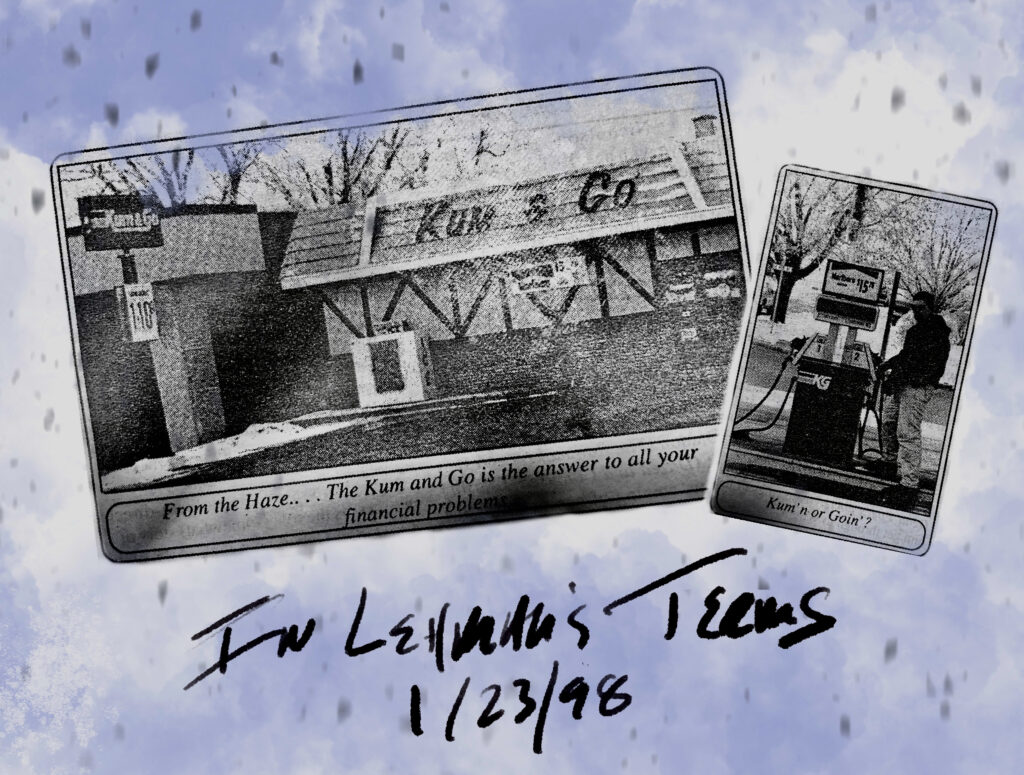
It all started when friends on my law school newspaper refused to believe that there was a gas station chain in the Midwest named the Kum & Go. With the promise of a two page spread in the next edition if I could prove it, In Lehman’s Terms was conceived.
For the next two years, I took slivers of actual events and amplified them in the gonzo style of Hunter S. Thompson to critique the ridiculousness of 500 mostly affluent law students trying to coexist in a small Vermont village of 500 farmers and loggers.
Being a hardscrabble farm kid from South Dakota who was maxing out student loans and credit cards to pay for a law degree to change my circumstances, I had a foot in both worlds. I recognized the lives of the locals. But, I thought it sure would be nice to be an affluent attorney. As Kris Kristofferson sang in The Pilgrim, Chapter 33, I “was a walking contradiction …”. To make sense of it all, I invented another world in which to visit on a regular basis through gonzo satire.
A Swirling Abstract Mosaic of Color
As the In Lehman’s Terms story was spun, I secured Kum & Go sponsorship to pay my law school tuition for the Spring 1998 semester after I burned through my student loan money over one long weekend. Committing to the bit, I reported that one of the three criteria the Kum & Go gas station in Sioux Center, Iowa required was that I spell come and all its derivatives with the company spelling. I dutifully misspelled “kum” in each article from then on. I had to catch myself when taking law exams as it had “bekum” second nature after a while. The third of three purported sponsorships requirements was, shall I say, a tad more explicit.
The satirical bizarre verse was an escape. It gave me a slightly fictionalized respite from the mental landscape of fear and anxiety where I could enjoy a swirling abstract mosaic of color through tales of the ill-fitting T-shirts, fox hats, and the one downside of filling your living room with green jello. That, of course being, jello stains your fingernails.
I made Kristofferson’s lyric accurate for my life.
He’s a walkin’ contradiction, partly truth and partly fiction.
– Kris Kristofferson, The Pilgrim, Chapter 23
Dolphins and Country Outlaws
I met Kristofferson once when he played a show at this little 500 seat club called The Birchmere in Alexandria, Virginia. My daughters (8, 5, and 3 at the time) had just watched the Dolphin Tail movies and loved Kristofferson’s portrayal of a grandfatherly character. While they didn’t know his music, knowing Winter the dolphin was good enough reason for them to want to go. They were the youngest three people at the show. We sat at a table directly stage left where performers enter and exit to the dressing room.
Kristofferson came out for his solo show and did a double take as he saw my girls cheering. He sang in a raspy voice as he picked his guitar. The differing worlds of a country outlaw and three year old dolphin lover melded together that night. The girls wanted to stay after to meet him. So, we did. He graciously shook their hands. My five year old asked him about the dolphin Winter.
What I noticed from the encounter was his boots.
Growing up in South Dakota, a person’s boots tell a lot. Wearers of three-inch heal buckaroo style boots are likely cowboys from west river South Dakota. One-inch heal pointed toe boots mean the person is probably a farmer from eastern South Dakota. If a person wears zipper boots, well, they better be able to run fast.
The luster of newness and several other layers of the full grain leather were long gone from Kristofferson’s boots. They were most likely older than me. And, his boots had seen some things. The boots had seen the poets and the pickers, the prophets and the pushers, the pilgrims and the preachers that Kristofferson sang about. A cliche is a cliche for a reason. As the cliche goes, Kristofferson walked miles in his own shoes, er boots.
As I reflect on where the twenty-two years from when In Lehman’s Terms was conceived in a dive bar in South Royalton, Vermont have gone, Kristofferson’s boots keep coming to mind. As do mine.
Firewood Brokers Wear Hunting Boots
I purchased a pair of waterproof Danner boots after I graduated from college but before I started law school. The luster of newness was quickly eaten away by the mist of liquid fertilizer, herbicides, and pesticides I walked through during my last summer of paid manual labor spraying lawns in my hometown for $5.25 an hour.
I wore them throughout law school — from my first class to my last. In fact, if you look closely at the grainy photo of me standing next to the Kum & Go gas pump, I have them on.
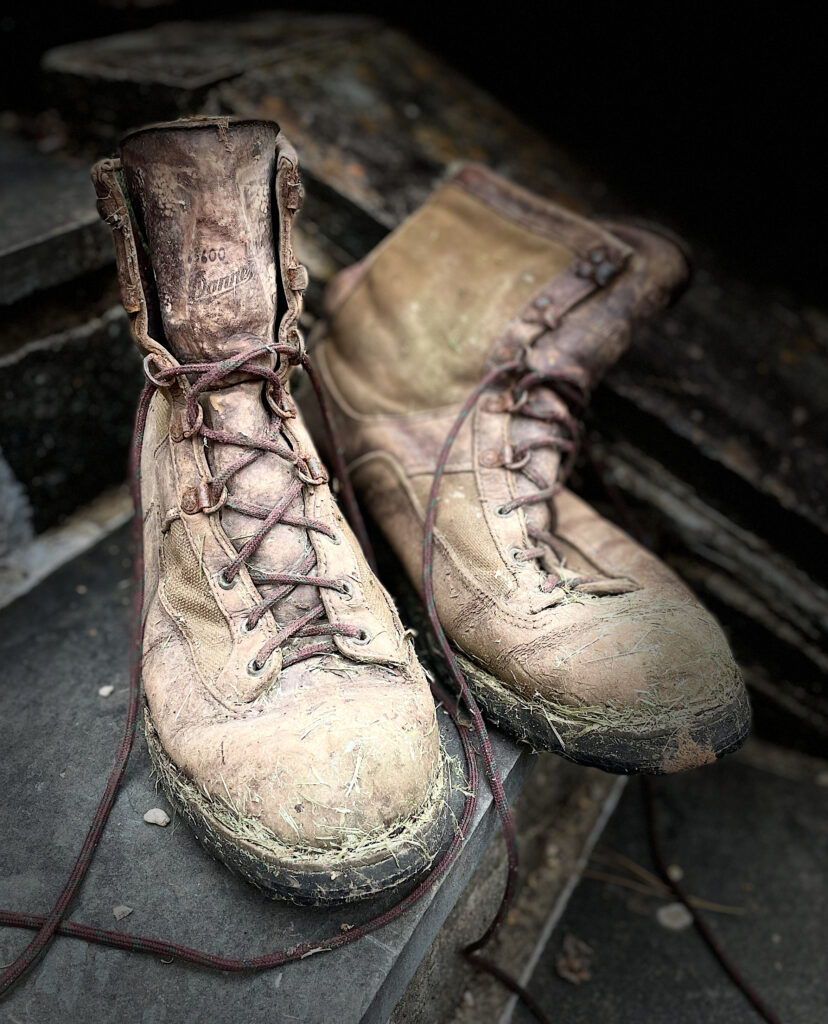
They were a fixture of my over-the-top striped bib overall and flannel shirt swirly shack (i.e. bar) attire that I donned most weekends in my twenties to flout the self-important bar scene in D.C. It also helped sell my fabricated answer to the ubiquitous “who do you work for” question that seems to start every conversation. Instead of delving into my actual day job, I’d say that I was a firewood broker. I’d explain that I connected people who needed firewood with those who sold firewood for a tidy commission. That was usually enough to be left alone.
My boots have aged along with me. In my thirties, they chilled in my closet mostly. In my forties, I wear them for cutting down our Christmas tree each December and doing my own yard work instead of others.
The boots have seen and been through a lot. As have I.
We all have.
Conjuring the Senses
I could never have imagined that twenty-four years after I purchased these boots, we would be in month ten of a worldwide pandemic. Or, that the chasm between peoples beliefs in what is fundamentally right and wrong is so wide and perilous.
On September 11, 2001, I hustled through the halls of the U.S. Capitol evacuating in fear for my life from a terrorist attack. Just a month later, 37 of my colleagues and I were exposed to anthrax in the largest U.S. bio-terrorism attack. This time, we gathered in an ornate room just off the Senate chamber as government officials professed to know how to treat us. For the second time in two months, I contemplated my potential death.
While it may have been 20 years ago, the photos from yesterday took me back to those days in 2001. I remembered the fear of dying. I felt the cold from the drafty windows and high ceilings. I heard the rapid clicking of shoes hitting ornate tile floors as their owners rushed for safety. I had hoped that no one would have to experience those feelings again. I sat with that disappointment for a long time as I surrendered to the emotion.
Turning to an Old Friend
Writing In Lehman’s Terms helped me process the complexities and nuances of my early twenties life. I rhetorically asked myself in a column at the time whether “it was whimsical verse, that I didn’t know how to spell, or something else.” I didn’t appreciate at the time that it was something else. It was a vehicle for me to meditate on life and wrestle with what I believed, who I was, who I wanted to be, and how I could contribute to the societal good.
A lifetime later, rekindling it seems appropriate.
So, I have dusted off In Lehman’s Terms. I hope to write about the experiences shaping my world today and strive to understand the worlds of others. How have I changed? How has the world changed? What can I do next to contribute? And, maybe just maybe, through the creative process these disparate seeming worlds can meld and heal.
Simple, right? Not really. But, I will do my best to share it with you as this new iteration of In Lehman’s Terms evolves.
Thanks for reading.

You write wonderfully, I will continue to read your writings!!